From the beauty counter to a nutrition practice: my AKN training
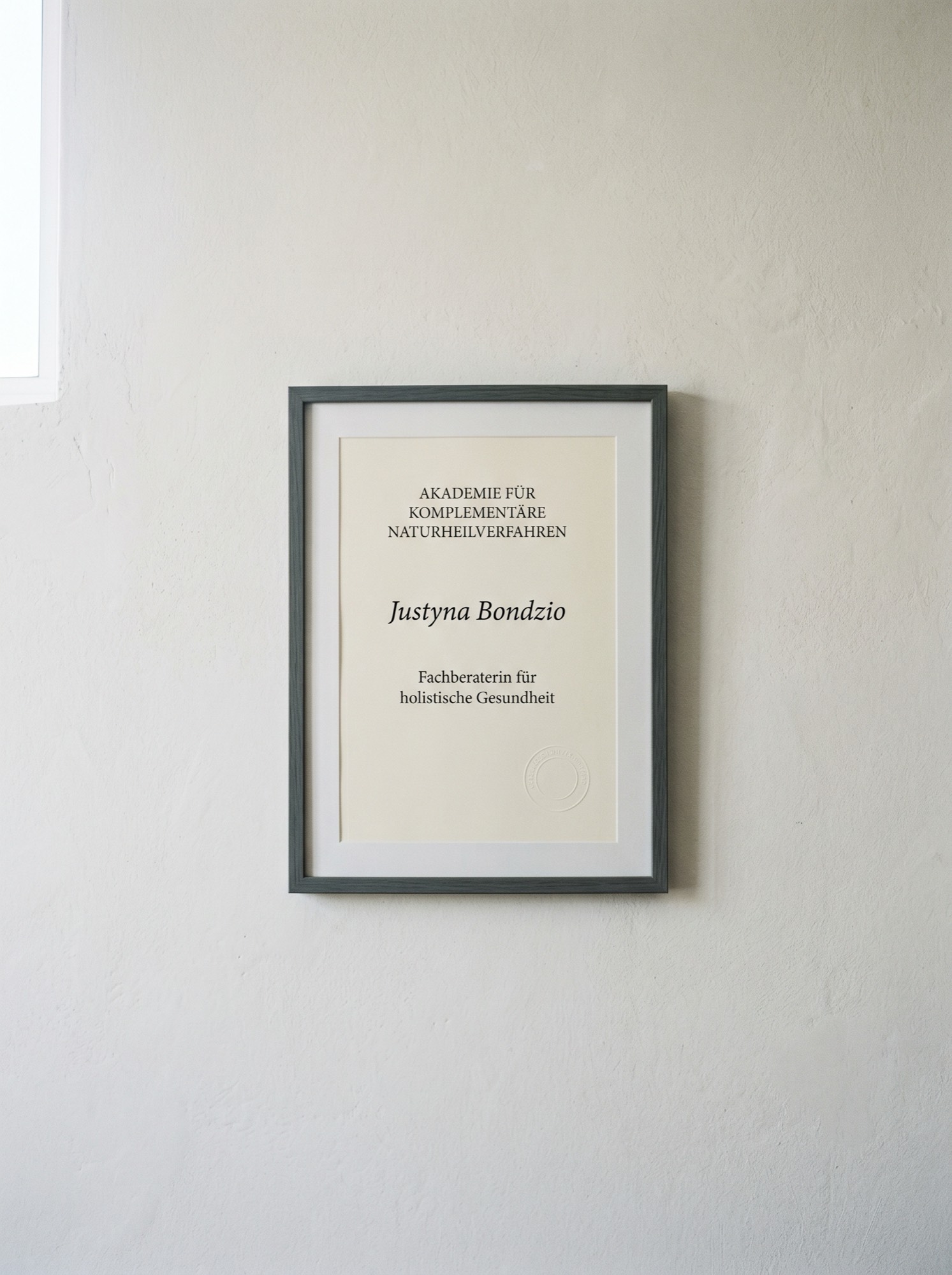
There was no moment when I crossed from cosmetics to nutrition. There were fifteen years during which I gave the same answer to the same question, and at some point I realised the answer belonged somewhere else entirely.
I trained as a state-recognised medical cosmetologist in Hamburg in 2010. It is a German vocational programme with two roots. Skin anatomy, microcirculation, simple pathology on one side. Day-to-day practice on the other. In day-to-day practice, a woman walks up and says: My skin is doing strange things, what do we do? And you answer the question as well as you can.
Between 2010 and 2025 I answered that question in four languages, in five countries, and in houses whose names you cannot invent. Nivea Haus in Hamburg. L'Occitane. LVMH Benefit. Spa Group Europe at the Elbphilharmonie. Today, Cosmo Beauty Brand House in Berlin. I know this industry, and I know it well enough to know what it can and cannot do.
What it can do
It can calm an irritated skin. It can take a woman who has been sleeping badly for weeks and place her, for ninety minutes, in a state where her system is finally allowed to down-regulate. That is not a small thing. That is a real therapeutic function. Anyone who has worked in a spa knows how much a person is carrying around before they lie down on the treatment bed.
What it cannot do
It cannot explain why the skin goes off again on Thursday at four. It cannot answer why the woman who has tried every decent routine for five years is no further forward. It cannot repair sleep, hormones, digestion, stress. It can sense it, it can name it, and it can send the client home well. That is the limit.
The longer I stayed in the industry, the less I could ignore that gap.
Why the AKN
I thought for a long time about what the right bridge would be. Heilpraktikerin: too large, wrong domain, not licensed in Portugal. Ökotrophologie: too academic, wrong moment (my child was nine at the time). A US certification: too detached from the German language I want to work in. The Academy for Complementary Natural Therapies in Lucerne was for me the soberest option. A Swiss, German-language training that produces holistic health consultants, with a curriculum that does not apologise. Anatomy, physiology, pathophysiology, nutrition, micronutrients, metabolism, the hormonal system, digestion, stress physiology.
It is not a clinical qualification. I am not allowed to diagnose, to treat illness, to replace therapy. I want to say that clearly. Including here, because too many people on the internet pretend to be something they are not. What I am allowed to do: accompany adults toward a nutrition and a daily life that will carry them over decades.
What the training actually was
Online modules across two years, plus in-person weeks in Lucerne, plus oral and written exams, plus two supervised case studies with real clients. The hardest phase was pathophysiology: endocrine axes, digestive regulation, foundations of autoimmunity. I have never learned so much anatomy in my professional life. And I noticed what had been missing before. A shared vocabulary with the doctors and coaches my clients are already working with.
What shifted for me
Three things.
First, the order of the questions. Before the AKN, at the start of a conversation, I asked what someone eats. After the AKN, I ask how someone sleeps, moves, recovers. The eating almost always falls into place by itself, about an hour later, with less drama.
Second, the discipline of limits. I say that belongs to a doctor much earlier now. A wobbly thyroid. Iron values that are tipping. A recurring gastritis. Those are not my territory. I can think about the life-shape around them, no more than that.
Third, trust in the simple. If you put six years through training (three in cosmetics, two in the AKN, one in Portuguese and Spanish) you end up, oddly, with less appetite for complicated prescriptions. What makes the difference for most of my clients is not the exotic food they have not yet tried. It is the quarter of an hour they no longer spend on their phone in the morning. That is banal. It is also what holds.
What the practice looks like now
Small. Very small. I continue to work in the beauty industry by day. The practice runs in the background, through word of mouth, individual conversations, often in Portuguese or English. My pace is slow. I want to build the clinical muscle carefully, not feed it from marketing.
That is why this page carries no package, no waitlist, no pricing. It carries a form for writing and a journal. People who need me write to me. The rest does not happen on a website.